You probably use phrases that were born during the American Revolution without even knowing it. Expressions like "give me liberty or give me death" and "don't tread on me" didn't just stay in history books they slipped into everyday English and shaped how Americans talk, write, and argue. Understanding how Revolutionary War slogans influenced modern English language helps you see the hidden history behind words you hear in politics, sports, business, and daily conversation.
What Revolutionary War slogans actually were
Revolutionary War slogans were short, punchy phrases used to rally colonists, build unity, and express opposition to British rule. They appeared on pamphlets, flags, newspapers, and in speeches between roughly 1765 and 1783. These weren't casual remarks they were crafted to be memorable, repeatable, and emotionally powerful. That's exactly why so many of them survived long after the war ended.
Many of these slogans drew on Enlightenment ideas about freedom, natural rights, and self-governance. Others were practical calls to action. Together, they created a shared vocabulary for an emerging nation, and that vocabulary never fully left the English language.
How did war slogans from the 1700s end up in modern speech?
The short answer: repetition and cultural memory. Phrases that get repeated across generations become part of a language's DNA. Revolutionary slogans were printed on currency, taught in schools, quoted in political speeches, and referenced in legal arguments. Over time, people stopped thinking of them as historical quotes and started using them as regular expressions.
Some phrases kept their original meaning. Others shifted. "No taxation without representation" still means roughly the same thing today people use it in debates about government accountability. But a phrase like "join, or die" has stretched far beyond its original context and now shows up in everything from sports team slogans to advertising campaigns.
You can explore more about common expressions that originated during the Revolutionary War era to see how specific phrases made the jump from wartime propaganda to everyday language.
Which Revolutionary War slogans do people still use today?
Several phrases from the Revolutionary period remain active in modern English. Here are the most recognizable ones:
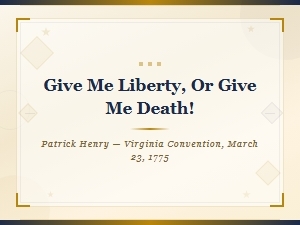
- "Give me liberty, or give me death" Patrick Henry's 1775 line is still used to express fierce commitment to freedom or any cause someone holds dear.
- "No taxation without representation" This phrase appears regularly in political debates, protests, and discussions about government policy.
- "Don't tread on me" Originally tied to the Gadsden Flag, this slogan now represents personal independence and resistance to overreach. You'll see it on bumper flags, T-shirts, and protest signs.
- "Join, or die" Benjamin Franklin's woodcut image and slogan get reused whenever unity is the message in politics, advertising, and even sports.
- "Live free or die" New Hampshire's state motto, originally from General John Stark, shows up in popular culture, military contexts, and everyday arguments about personal freedom.
- "We hold these truths to be self-evident" While technically from the Declaration of Independence rather than a battle slogan, this phrase has entered legal language, philosophical debate, and casual conversation as a way to say "this should be obvious."
For a closer look at the specific quotes that shaped how Americans speak, see our famous quotes from the American Revolution.
Why do these old slogans still resonate in modern English?
Three reasons keep these phrases alive:
- They're emotionally direct. Revolutionary slogans didn't use complicated language. They were short, bold, and clear which is exactly what makes a phrase stick in people's minds.
- They tap into universal ideas. Freedom, resistance to unfair authority, and collective action aren't limited to one time period. These themes come up constantly, and the old slogans give people ready-made language to express them.
- Americans inherit them culturally. These phrases are embedded in education, government documents, monuments, and media. Even people who aren't history fans absorb them through osmosis.
- Wrong attribution. "Give me liberty, or give me death" is widely credited to Patrick Henry, which is correct. But some people mistakenly attribute "live free or die" to the founders it was actually General John Stark, decades after the Revolution.
- Stripping the context. Slogans like "don't tread on me" had specific military and political meanings. Using them casually without understanding where they came from can lead to miscommunication or unintended political signals.
- Confusing slogans with legislation. "No taxation without representation" was a rallying cry, not a legal principle written into the Constitution. The actual legal framework around taxation is more complex than the slogan suggests.
- Assuming all founders agreed. Revolutionary slogans represent specific viewpoints from specific people. The founders disagreed with each other on many issues, and not every popular slogan reflected a consensus.
- Know who said it and when. A quick fact-check prevents embarrassing misquotes.
- Match the tone. These phrases carry weight. Dropping "give me liberty or give me death" into a casual complaint about a parking ticket undercuts the phrase and makes your point less convincing.
- Use them to strengthen an argument, not replace one. A slogan can open a speech powerfully, but it can't carry an entire argument by itself.
- Acknowledge the history. If you're writing for an audience that might not know the origin, a brief mention of where the phrase comes from adds credibility and context.
- Start paying attention to the phrases you hear in political speeches, news coverage, and advertising. You'll be surprised how often Revolutionary-era language shows up.
- Read primary sources. Many Revolutionary pamphlets, speeches, and letters are available free online through the Library of Congress. Reading the original context gives you a richer understanding of what these slogans meant and why they stuck.
- Practice using these phrases with awareness in your own writing. They can add historical depth and persuasive power when used thoughtfully.
- Explore the broader list of expressions that came from the Revolutionary War to build a fuller picture of how that era shaped the language you speak today.
- Verify the original speaker and date before quoting.
- Understand the historical context behind the phrase.
- Make sure the tone matches your situation.
- Use the slogan as a hook or support not your entire argument.
- Add brief context so your audience understands the reference.
How Revolutionary War slogans shaped political language
Modern political speech in America borrows heavily from Revolutionary-era slogans. Politicians on all sides of the spectrum invoke "liberty," "tyranny," "freedom," and "representation" all vocabulary that was sharpened and popularized during the Revolution.
Protest movements have picked up this tradition too. The Tea Party movement took its name directly from the Boston Tea Party of 1773. Occupy Wall Street echoed Revolutionary frustrations about economic fairness. Even debates about gun rights and government surveillance regularly reference language rooted in 18th-century resistance slogans.
This isn't just American. The phrase "no taxation without representation" has been used in British political debates, particularly regarding places like Washington, D.C. and overseas territories.
What mistakes do people make when using these phrases?
Because these slogans have been around so long, they're easy to misuse or misattribute. Here are common errors:
How to use Revolutionary War phrases correctly in writing and speech
If you want to reference these slogans in your own communication, a few guidelines help:
What can you do next?
If this topic interests you, there's a straightforward way to keep learning and applying it:
Quick checklist for using Revolutionary War slogans in modern contexts:
 Common Revolutionary War Phrases and Their True Meanings
 Iconic Phrases From Revolutionary War Leaders Explained
 Common Expressions That Originated During the Revolutionary War Era
 Famous Quotes From the American Revolution for Students to Inspire and Learn
 Medieval Period Reforms: Key Events Summary for Students
 Crafting Varied Sentences About the Magna Carta in Essays